
The fastest AI certification roadmap for developers in 2026: start with a free foundation credential (AI+ Foundation or Google AI Essentials), then take the vendor certification matching your cloud stack (AWS AI Practitioner, Azure AI-102, or Google Professional ML Engineer), and finally add a generative AI specialisation such as IBM’s RAG & Agentic AI certificate — the highest-paying track, at $140,000–$220,000+.
The AI job market looks nothing like it did two years ago. What was once a niche technical specialty has become a core competency across virtually every industry and employers are struggling to separate candidates who genuinely understand AI from those who have little more than surface-level familiarity with ChatGPT.
Certifications have stepped into that gap. They are now one of the most reliable signals a developer can send to a hiring manager: structured, validated knowledge, backed by a name the market trusts.
The numbers bear that out. AI-related roles are projected to grow 40% in the coming years, and professionals with verified AI credentials earn anywhere from 25–50% more than those without formal training. Demand for AI-enabled skills more than doubled year-over-year in 2025–2026, with the fastest-growing areas being AI integration, LLM engineering, and agentic AI development.
This guide lays out a practical, actionable certification roadmap for developers at every level. From those just starting out to senior engineers who want to validate specialist skills and command premium salaries.
Not a developer? This roadmap is technical — see our guide to top AI certifications for non-technical professionals instead.
Why AI Certifications Matter More Than Ever in 2026
By 2026, the AI certification market had expanded from fewer than a dozen recognized credentials in 2023 to well over 100 across five major categories: vendor platforms, foundational literacy, technical ML/AI, domain-specific credentials, and ethics and governance. That explosion of options is both an opportunity and a problem, it makes choosing the right certification more consequential than ever.
Several forces are driving the urgency:
- Credential inflation is real. Resumes claiming “AI proficiency” have become ubiquitous. Certifications from credible providers like Google, AWS, Microsoft and IBM cut through the noise because hiring managers trust the underlying assessment process.
- Generative AI has become its own category. Two years ago, most AI certifications focused on classical machine learning. Employers now specifically seek validated skills in prompt engineering, RAG architectures, agentic AI, and responsible deployment. The certification landscape has finally caught up with how AI is actually used in production.
- Regulatory and compliance pressure is growing. Some emerging AI governance frameworks explicitly reference or require certified competency, particularly in finance, healthcare, and the public sector.
- AI adoption in development workflows is accelerating. As of early 2026, roughly 82% of developers report using AI tools weekly, and approximately 41% of all code is now AI-assisted. Developers who understand the underlying models and not just the tools, are commanding a growing premium.
The Certification Landscape: Five Key Categories
Before picking a specific credential, it helps to understand the five domains the market has organized around:
1. Vendor Platform Certifications
Offered by the major cloud providers like Google Cloud, AWS, and Microsoft Azure. These are the most employer-recognized credentials in the market. They validate your ability to build, deploy, and maintain AI systems in production on a specific cloud stack. If you already work in one of these ecosystems, this category should be your primary focus.
2. Foundational AI Literacy
Entry-level, vendor-neutral certifications designed to establish baseline knowledge in AI concepts, ethics, and applications. Ideal for developers who are new to the field or need a quick credential before targeting a more advanced program.
3. Technical AI/ML Engineering
Deep technical certifications covering machine learning theory, model architecture, MLOps, and production deployment. These sit at the intersection of software engineering and data science and tend to carry the highest salary premiums.
4. Generative AI & LLM Specializations
The fastest-growing credential category in 2026, covering foundation models, prompt engineering, RAG systems, fine-tuning, and agentic AI. Specialists in this area command salaries of $140,000–$220,000+.
5. AI Ethics, Governance & Responsible AI
A growing area as organizations navigate regulatory requirements and reputational risk. Best suited for senior developers, architects, and team leads moving into advisory or leadership roles.
The 2026 AI Certification Roadmap by Experience Level
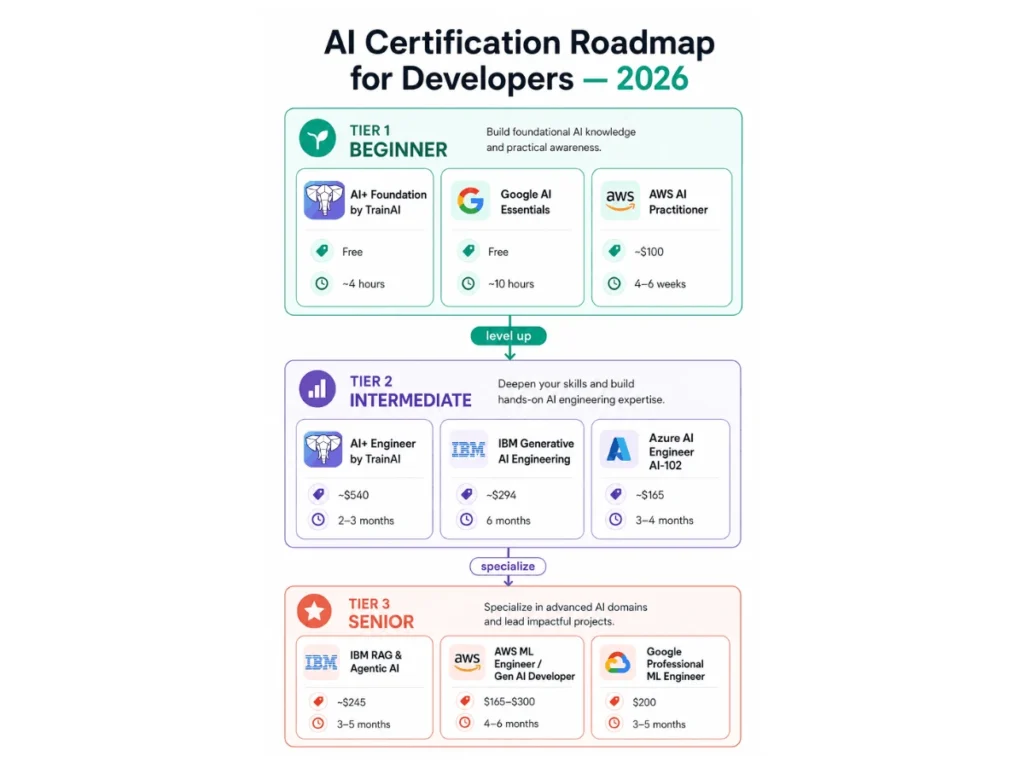
Beginner Developers (0–2 Years of Experience)
If you are new to AI, the goal at this stage is to build foundational fluency before committing to a costly or time-intensive advanced credential. Start here:
AI+ Foundation
- Cost: Free (Access via TrainAI)
- Time commitment: ~4 hours
- Best for: Establishing baseline AI literacy quickly
- What it proves: Familiarity with AI concepts, tools, and use cases in the workplace
Google AI Essentials
- Cost: Free (via Google Skills Starter, 35 free credits/month)
- Time commitment: ~10 hours
- Best for: Establishing baseline AI literacy quickly
- What it proves: Familiarity with AI concepts, tools, and use cases in the workplace
Microsoft Azure AI Fundamentals (AI-901)
- Cost: ~$99
- Time commitment: 2–4 weeks
- Best for: Non-technical and junior developers entering Microsoft-stack environments
- Note: Microsoft’s AI-900 is retiring on June 30, 2026 and is being replaced by AI-901, currently in beta. Verify the latest status on Microsoft’s official certification page before enrolling.
AWS Certified AI Practitioner
- Cost: ~$100 (View Details)
- Time commitment: 4–6 weeks
- Best for: Developers already working in AWS environments who need a credentialed starting point
Recommended first step: If you have never built an AI application, spend one month on AI+ Foundation plus a hands-on Python AI project, then pursue the vendor certification that matches your employer’s cloud stack.
Intermediate Developers (2–5 Years of Experience)
At this level, you have programming fundamentals and want to transition meaningfully into AI engineering or add AI capabilities to your existing role. These are the certifications with the strongest near-term career ROI for this group:
IBM Generative AI Engineering Professional Certificate
- Cost: ~$49/month on Coursera (roughly $294 over 6 months)
- Time commitment: 5–7 months
- What you’ll learn: Prompt engineering, working with LLMs (GPT, LLaMA), building NLP applications, LangChain, RAG architectures, fine-tuning, and deploying AI agents
- Salary impact: Strong positioning for generative AI engineering roles; the fastest-growing segment of the AI job market
- Best for: Developers, data scientists, and ML engineers who want comprehensive grounding in production LLM development. IBM refreshed this program in 2025 with new generative AI content, so the curriculum reflects current practice.
Microsoft Azure AI Engineer Associate (AI-102)
- Cost: ~$165
- Time commitment: 3–4 months
- What you’ll learn: Implementing AI solutions across Azure’s ecosystem — Cognitive Services, OpenAI integrations, bot frameworks, and responsible AI practices
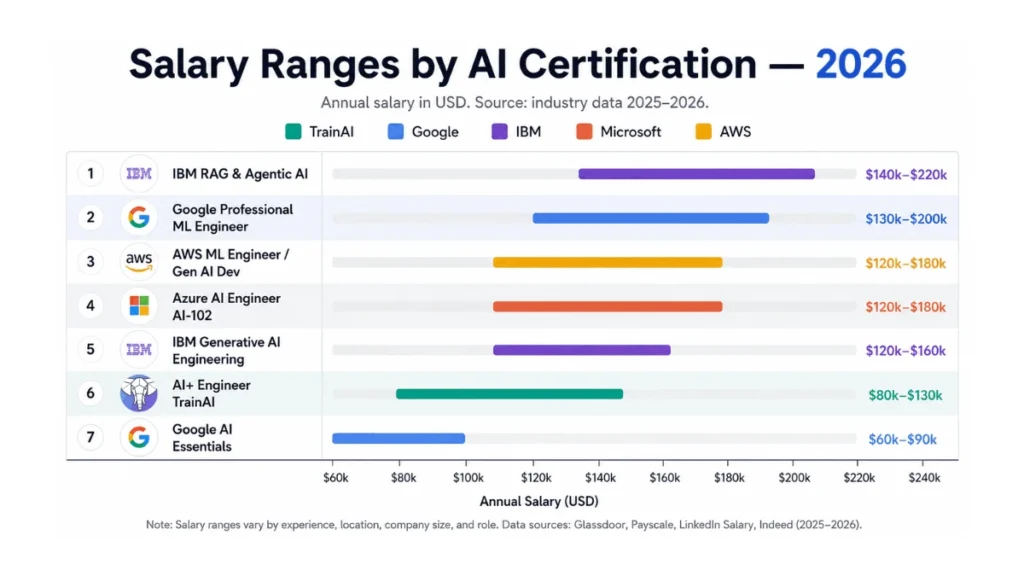
- Salary impact: Roles aligned with AI-102 commonly fall in the $120,000–$180,000 range, particularly in Microsoft-stack companies
- Best for: Developers in enterprise environments already using Azure, Microsoft 365, or Dynamics
IBM RAG and Agentic AI Professional Certificate
- Cost: $147–245 on Coursera
- Time commitment: 3–5 months
- What you’ll learn: Retrieval-augmented generation systems, autonomous AI agents, advanced LLM integration
- Salary impact: RAG and agentic AI specialists command some of the highest premiums in the market — $140,000–$220,000+
- Best for: Intermediate to advanced developers who want to specialize in the cutting-edge techniques employers are most actively hiring for in 2026
AI+ Engineer
- Cost: ~$540 on TrainAI (View Details)
- Time commitment: 2–3 months
- What you’ll learn:
Design production ML architectures, Deploy and monitor ML models, Build robust training pipelines, Implement MLOps best practices - Best for: Developers with Python and ML fundamentals who want a single credential that validates full-stack AI engineering capability, from model design through to production deployment
Senior Developers & ML Engineers (5+ Years of Experience)
Senior professionals should target credentials that signal deep technical mastery and carry recognized prestige among engineering leadership. The two standout options in this tier are:
Google Professional Machine Learning Engineer
- Cost: $200 (plus applicable tax); 2-hour exam
- Time commitment: 3–5 months of preparation
- What it covers: Framing ML problems, architecting ML solutions, designing data preparation strategies, developing and evaluating models, automating ML pipelines, and monitoring production systems
- Salary impact: Average salary approximately $165,000; roughly 25% salary uplift over non-certified peers
- ROI verdict: Consistently rated among the strongest-ROI certifications available. Google Cloud has a smaller market share than AWS or Azure, but certified professionals often command a premium precisely because GCP expertise is scarcer.
- Preparation resources: Free learning paths are available through Google Cloud Skills Boost
AWS Certified Machine Learning Engineer – Associate / Specialty
- Cost: $165 (Associate) to $300 (Professional-level Generative AI Developer) – View Details
- Time commitment: 4–6 months
- What it covers: Building scalable ML models, MLOps pipelines, data engineering, and — for the Generative AI Developer credential — AWS Bedrock and production generative AI application development
- Salary impact: AWS-certified ML professionals earn $120,000–$180,000 annually, with a reported average 27% salary increase post-certification
- Best for: Senior engineers in cloud-native or startup environments where AWS dominates the infrastructure stack
Specialist Tracks: Where the Premium Salaries Are
Beyond the vendor-platform roadmap, three specialist tracks are commanding outsized compensation in 2026:
Agentic AI & RAG Engineering
The most in-demand specialization of 2026. Developers who can design and deploy autonomous AI agent systems — including multi-agent architectures, tool use, and retrieval-augmented generation — are in extraordinarily short supply relative to demand. The IBM RAG and Agentic AI Professional Certificate is currently the most structured credential in this space.
MLOps & AI Infrastructure
As organizations mature from AI experimentation to production deployment, the demand for engineers who understand model monitoring, CI/CD pipelines for ML, data versioning, and drift detection has spiked. This is a high-value specialization for developers with a DevOps or platform engineering background.
AI Ethics, Safety & Governance
Senior developers and architects moving into leadership roles increasingly need credentials in responsible AI. The IAPP AI Governance Professional certification (~$400–$600) is among the most respected in privacy, risk, and compliance communities, though it requires 40–60 hours of preparation and is best suited to professionals with a governance or legal-adjacent background.
How to Choose: A Decision Framework
With over 100 credentials in the market, the single most important selection criterion is alignment with your actual stack and role. Here is a simplified framework:
| Your Situation | Start Here |
|---|---|
| Never built an AI app | AI+ Foundation (Free) |
| Working in AWS | AWS AI Practitioner → AWS ML Engineer |
| Working in Azure / Microsoft stack | Azure AI-901 → Azure AI-102 |
| Working in Google Cloud | Google AI Essentials → Google Professional ML Engineer |
| Building with LLMs / generative AI | IBM Generative AI Engineering Professional Certificate |
| Targeting agentic AI specialization | IBM RAG and Agentic AI Professional Certificate |
| Senior engineer, max salary impact | Google Professional ML Engineer |
A few additional principles worth anchoring to:
- Avoid skipping levels. Career switchers who jump directly to advanced certifications without foundational grounding often waste both time and money. The decision framework above accounts for this.
- Hands-on projects outweigh theory. The most valuable certifications require you to build actual applications, not just pass multiple-choice exams. Prioritize programs with project components.
- Provider credibility matters. Certifications from IBM, Microsoft, Google, and AWS carry significantly more weight with employers than offerings from lesser-known providers. This is not about prestige — it is about hiring managers having a benchmark they trust.
- Recency counts. Several credentials expire after two years, ensuring holders maintain current knowledge. Treat certification not as a one-time event but as a recurring investment in your currency as an engineer.
Building Your Study Plan: Practical Tips
Getting certified is one thing. Getting certified efficiently — while working full-time — is another. Here is what works:
Dedicate time in blocks, not minutes. One focused two-hour study session per day is more effective than scattered 15-minute intervals. Protect that block.
Use official free resources first. Google Cloud Skills Boost, AWS Skill Builder, and Microsoft Learn all offer free or low-cost preparation pathways aligned directly to their exams. Exhaust these before paying for third-party prep courses.
Build as you learn. Don’t defer project work until after the exam. Build small applications — a RAG chatbot, a classification pipeline, an agent with tool use — as you progress through the curriculum. This reinforces concepts and generates portfolio evidence.
Join a study cohort. Online communities (particularly on Discord and Reddit) for each major certification are active and useful. Peers who are a few weeks ahead can save you hours of confusion.
Track your timeline. Set a realistic exam date before you start studying. Candidates with a fixed target date pass at significantly higher rates than those who study indefinitely.
The Long-Term Picture: Compounding Returns
A developer who begins building structured AI credentials today and maintains consistent effort throughout 2026 will end the year with a portfolio of projects, two or three recognized certifications, and measurable production experience — placing them in the top tier of AI-capable candidates globally.
The window for differentiation through AI credentials remains wide open, but it will not stay that way. As AI literacy becomes a standard expectation rather than a differentiator, the premium will shift toward depth of specialization. The roadmap above is designed with that trajectory in mind: start with the foundations, move to vendor-specific mastery, and layer in a specialist track that aligns with where both your interests and market demand converge.
The investment is real — typically 3–7 months of structured study per credential, plus exam fees ranging from $99 to $550. The returns, measured in salary impact, career optionality, and depth of technical understanding, are among the highest available to working developers in 2026.
Quick Reference: Top AI Certifications for Developers in 2026
| Certification | Provider | Cost | Duration | Best For |
|---|---|---|---|---|
| AI+ Foundation | TrainAI | Free | 4 hours | Beginners |
| AI Essentials | Free | 10 hours | Beginners | |
| Azure AI Fundamentals (AI-901) | Microsoft | ~$99 | 2–4 weeks | Beginners / Azure |
| AWS AI Practitioner | AWS | ~$100 | 4–6 weeks | Beginners / AWS |
| AI+ Engineer | TrainAI | ~$540 | 2–3 months | Intermediate / Full-stack AI |
| IBM Generative AI Engineering | IBM / Coursera | ~$294 | 6 months | Intermediate developers |
| Azure AI Engineer Associate (AI-102) | Microsoft | ~$165 | 3–4 months | Intermediate / Enterprise |
| IBM RAG & Agentic AI | IBM / Coursera | ~$245 | 3–5 months | Advanced / Specialist |
| AWS ML Engineer / Gen AI Developer | AWS | $165–$300 | 4–6 months | Senior / AWS |
| Google Professional ML Engineer | Google Cloud | $200 | 3–5 months | Senior / Max ROI |
Certification costs, durations, and exam formats are subject to change. Always verify current details directly with the certification provider before enrolling or registering for an exam.
Frequently Asked Questions
What is the best AI certification roadmap for developers?
Start with a free foundational credential (AI+ Foundation, ~4 hours, or Google AI Essentials), progress to the vendor certification matching your cloud stack (AWS AI Practitioner → ML Engineer, or Azure AI-901 → AI-102, or Google AI Essentials → Professional ML Engineer), then specialise in generative AI with a credential like IBM’s RAG & Agentic AI Professional Certificate.
Which AI certification should I get first?
A free foundation-level certification. AI+ Foundation takes around 4 hours and establishes baseline AI literacy; Google AI Essentials takes about 10. Only after that should you invest in a paid vendor credential — career switchers who skip straight to advanced certifications typically waste both time and money.
Are AI certifications worth it in 2026?
For developers, yes — professionals with verified AI credentials earn an estimated 25–50% more than those without formal training, and credentials from Google, AWS, Microsoft, and IBM give hiring managers a trusted benchmark amid widespread “AI proficiency” claims on CVs. The caveat: certifications open doors; hands-on project work closes offers. Do both.
Which AI certification pays the most?
Generative AI and agentic specialisations currently command the highest premiums: RAG and agentic AI specialists earn $140,000–$220,000+, and Google Professional ML Engineer holders average around $165,000 (roughly £120,000+ at senior level in the UK market) with a ~25% uplift over non-certified peers.
How long does it take to complete an AI certification?
Foundation certificates take 4–10 hours. Associate-level vendor certifications take 1–4 months of part-time study. Professional and specialist credentials (Google Professional ML Engineer, IBM Generative AI Engineering) take 3–7 months. A realistic full roadmap from zero to specialist is 12–18 months alongside a full-time job.
Do AI certifications expire?
Several do — cloud vendor certifications typically expire after two to three years and require renewal, which is intentional: it ensures holders keep current in a fast-moving field. Treat certification as a recurring investment rather than a one-time event.
Conclusion
The AI certification landscape in 2026 rewards intention over impulse. Pick the credential that matches your stack and experience level, build real projects alongside your studies, and treat each certification as a stepping stone rather than a destination.
If you’re starting at the foundation level, you can browse all TrainAI certifications — including AI+ Foundation, free and completable in an afternoon. Your roadmap is clear; the next step is simply to take it.
2 responses
One point that stood out is the shift from AI certifications being a nice-to-have to becoming a stronger hiring signal as the market gets more crowded. I’d be interested to see how you weigh certifications against hands-on project experience, especially for areas like LLM engineering and AI integration, since many employers seem to look for both validation and real-world implementation skills.
Certifications open the door, but real project work is what closes the offer. For LLM engineering especially, employers want proof you can handle messy real world implementation not just that you understand the theory. Both matter, but hands on experience is the stronger signal every time.