Artificial intelligence has moved well beyond chatbots and content generators. The next frontier — already reshaping how businesses operate — is agentic AI: systems that do not just respond to prompts, but plan, decide, and act on their own. If you have been seeing terms like AI agents, agentic AI, or autonomous AI systems and are not quite sure what they mean, read on.
AI Agent Meaning: What Is an AI Agent?
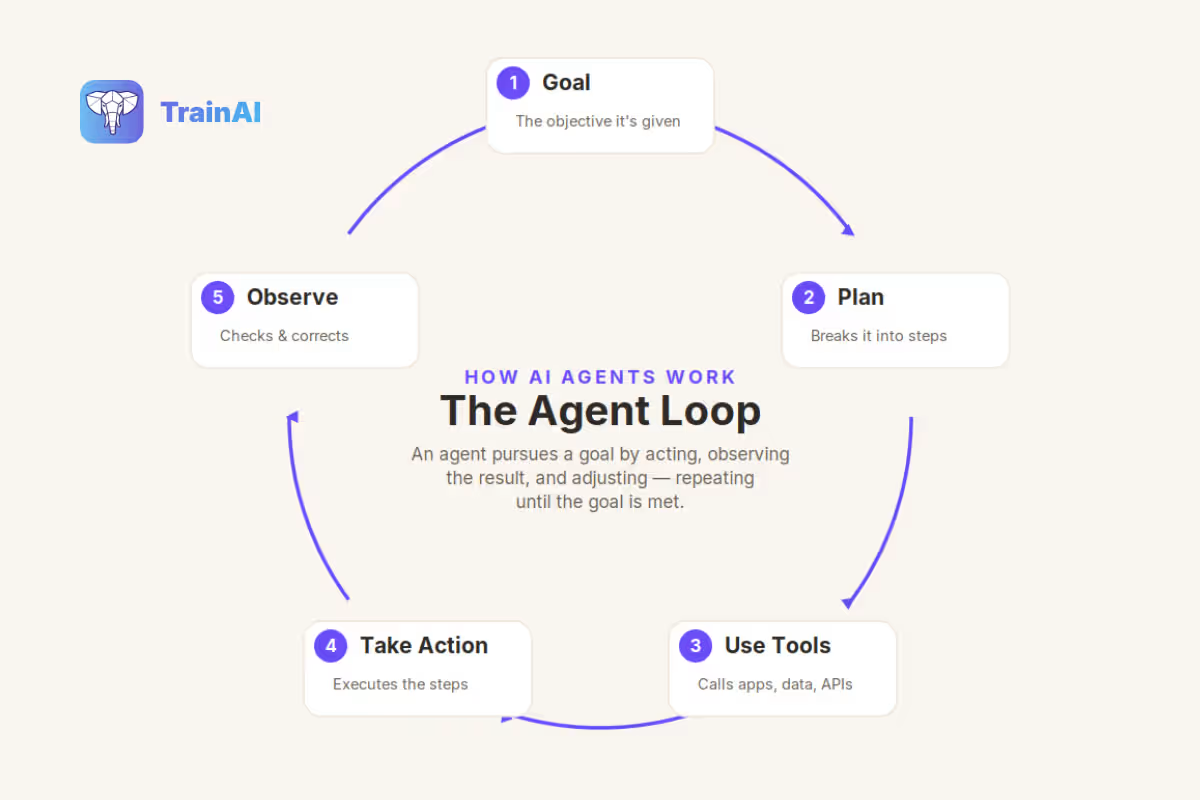
An AI agent is a software system that can perceive its environment, reason about a goal, and take actions to achieve it — often without step-by-step human guidance. Unlike a traditional chatbot that waits for your input and responds, an AI agent can independently break a complex task into subtasks, use external tools (APIs, databases, sheets, other software), and adapt its approach based on what it learns along the way.
A simple analogy: a chatbot is like a knowledgeable colleague who answers your questions. An AI agent is like that same colleague, but one who can also go away, do the research, book the meetings, and come back with results — without you managing every step.
Agentic AI: What Makes AI “Agentic”?
Agentic AI refers to the broader system in which one or more AI agents operate. The word agentic comes from agency — the capacity to act independently and purposefully.
Where a single AI agent handles a specific, well-defined task, an agentic AI system coordinates multiple agents — along with data sources and tools — to execute broader, multi-step workflows. Think of it as the difference between one specialist and an entire autonomous team working toward a shared goal.
AI Agent vs LLM: What Is the Difference?
This is one of the most common points of confusion. Let’s take a look.
A large language model (LLM) like ChatGPT, Claude, or Gemini is essentially a very powerful text processor. It understands language, generates responses, and can help with a wide range of tasks — but only when prompted. It does not take initiative, and it cannot act on the world: it cannot book a meeting, update a database, or run a piece of code on your behalf.
On the other hand, an AI agent uses an LLM as its “brain” for reasoning and language, but adds layers on top: memory, planning, tool use, and the ability to execute actions across external systems. The LLM understands what needs to be done; the agent actually makes it happen.
A useful way to think about it: an LLM is a brilliant consultant who gives you advice. An AI agent is that same consultant, but one who also carries out the work.
| LLM | AI Agent | |
|---|---|---|
| Core function | Generates text responses | Executes tasks autonomously |
| Needs prompting? | Every step | Sets its own sub-steps |
| Uses external tools? | No (unless added) | Yes — APIs, databases, apps |
| Takes real-world action? | No | Yes |
| Learns from feedback? | Requires retraining | Adapts in real time |
AI Agents Examples: Real-World Applications
AI agents are already deployed across industries. Here are some of the most concrete AI agents examples in use today:
Customer support: Salesforce’s Agentforce agents are handling non-emergency 101 calls for Staffordshire Police in the UK and managing taxpayer enquiries for the US Internal Revenue Service — routing issues, answering FAQs, and escalating complex cases to humans.
Software development: Coding agents like Claude Code and Devin can write, test, and debug code autonomously. By mid-2025, software development had become the most established use case for AI agents in production environments.
Research: OpenAI’s Deep Research agent browses the web, gathers data from multiple sources, synthesizes findings, and produces detailed reports — tasks that would take a human analyst hours.
Supply chain: Agentic systems monitor inventory levels, track shipping conditions, and proactively reroute shipments when delays are detected — without waiting to be asked.
Healthcare: Research teams have deployed agents to detect adverse events in cancer patients by analyzing clinical notes, reducing the need for manual record review.
Generative AI Agents Examples: A Specific Category Worth Knowing
Generative AI agents are a subset that combines the content-creation capabilities of generative AI with the autonomous action-taking of agents. Rather than simply generating text or images in response to a prompt, these systems can generate content and act on it. Like publishing it, routing it, or using it as input to the next step in a workflow.
Examples include agents that draft and send personalized email campaigns based on CRM triggers, systems that generate code and then automatically run tests and deploy it, and research agents that write structured reports from live data sources without human input at any stage.
This category is growing fast. According to Social Media Examiner’s 2025 report, 90% of marketers already use AI for written tasks, and an increasing share of those workflows are becoming agentic, where the AI does not just draft but also schedules, distributes, and optimizes.
Benefits of AI Agents
Why are companies investing so heavily in AI agents? The practical benefits are significant:
Automation of multi-step work: AI agents handle complex, multi-stage tasks end-to-end, not just individual steps. This frees up human teams for higher-value thinking.
24/7 operation: Agents do not take breaks, work across time zones, and can manage thousands of tasks simultaneously.
Adaptive decision-making: Unlike rule-based automation, agents can adjust their approach when conditions change, which makes them far more robust in dynamic environments.
Scalability: A single agentic system can do the work of many human operators for repetitive, high-volume tasks — without linear increases in cost.
Compounding improvement: Agents learn from feedback over time, meaning performance improves with use rather than staying static.
McKinsey reports that 62% of organizations are already using AI agents, and Gartner expects 40% of enterprise applications to include task-specific AI agents in 2026 — up from less than five percent in 2025.
What Skills Do You Need to Build AI Agents?
Building and deploying AI agents requires a specific skill set that goes beyond simply using AI tools. A capable agent developer needs to understand agent architecture, tool integration, multi-agent orchestration, production deployment, and testing and evaluation.
These are not skills you pick up by accident. They require structured, hands-on training.
Learn to Build AI Agents: AI+ Agent Certification
If you are ready to move from understanding AI agents to actually building them, our AI Agent course is designed for exactly that.
This hands-on programme takes you from the fundamentals of agent architecture all the way through to production deployment — covering agent patterns, tool integration, and real-world deployment strategies. Whether you are a developer looking to specialize, a working professional future-proofing your career, or a technical lead exploring agentic AI for your organization, this certification gives you practical, applicable skills from day one.
What you will learn:
- AI agent fundamentals and core concepts
- Designing effective agent architectures
- Building and testing AI agents
- Deploying agents to production
A Reality Check: Agents Still Need Human Oversight
For all their promise, AI agents are not “set and forget.” They can misread a goal, take a wrong action confidently, or chain small errors into a costly one, precisely because they act without waiting for approval. That’s why the organisations deploying them successfully pair agents with clear guardrails and humans who know when to step in. Getting that judgement right across a team is a training question as much as a technical one, which is why AI literacy across the workforce matters more, not less, as agents spread.
Not Sure If This Course Is Right for You?
Choosing the right AI course depends on your background, goals, and where you are in your career. If you are unsure whether the AI+ Agent certification is the right fit, take our career quiz. Answer a few quick questions and get a personalized recommendation for the courses best suited to you.
The Wrap Up
AI agents are not a concept for the future — they are running in enterprises today, automating complex workflows and delivering real results. Understanding what they are, how they differ from LLMs, and how to build them is quickly becoming one of the most valuable technical skills available.
The question is no longer whether agentic AI will matter to your career or organization. It already does. The question is whether you will be equipped to work with it.