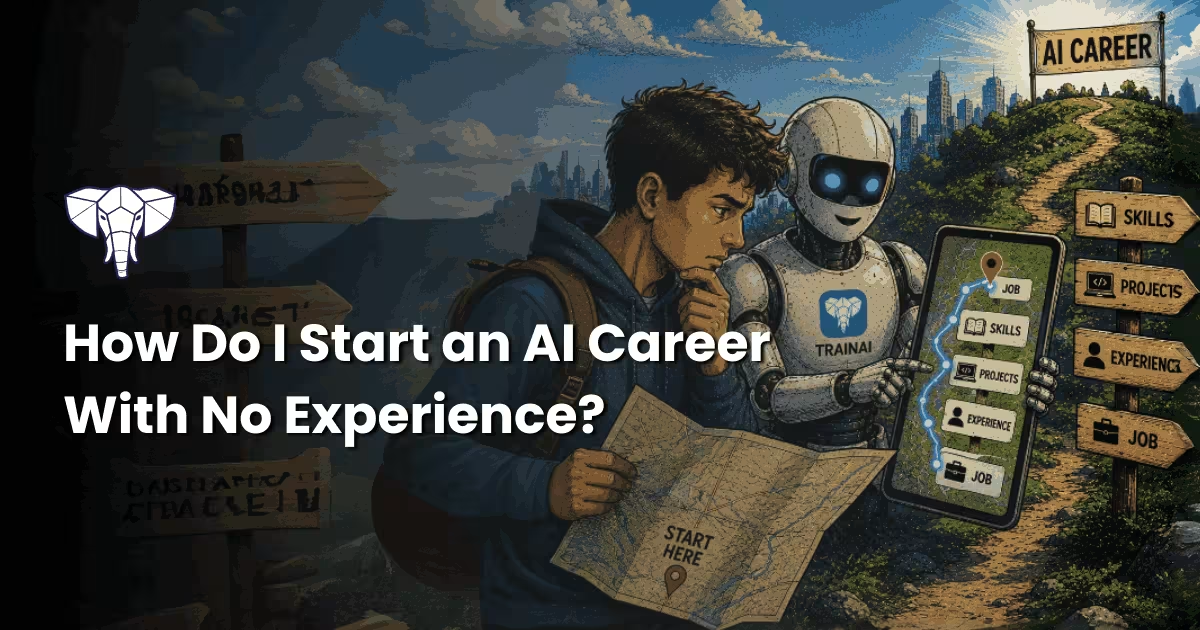
To start an AI career with no experience: pick an accessible entry role that matches your background (AI trainer, prompt engineer, AI content specialist, project coordinator, or governance analyst), spend 2–3 weeks on AI literacy, earn one recognised beginner certification, build a small portfolio of applied AI work, and start applying within 3–6 months. No computer science degree or coding is required for these roles.
Here is the honest answer to the question most people are too nervous to ask out loud: yes, you can get into AI without a tech background. No computer science degree, no coding history, no maths PhD required.
That might sound like the kind of reassurance every course platform uses to sell subscriptions. But the data backs it up. There is an entire tier of accessible, well-paying AI jobs that are perfect for candidates with no formal background, including career changers pivoting from retail, healthcare, education, and beyond. The AI industry has expanded well beyond research labs and engineering teams. It is now embedded in hiring systems, marketing platforms, financial tools, customer support software, and small business workflows and all of those environments need people who can work alongside AI, not just people who can build it.
What it does require is a willingness to learn deliberately, build evidence of your skills, and take the first step before you feel ready.
This guide shows you exactly how to do that.
First: Understand What “AI Career” Actually Means
The biggest misconception people have when researching AI careers is assuming every role requires coding. It does not.
AI offers multiple entry points depending on your background, strengths, and long-term goals. Some roles are deeply technical, while others focus on strategy, operations, or governance within AI-driven teams.
For someone coming from a non-technical background, the most accessible entry points are:
- AI Content Specialist: writing prompts, evaluating AI-generated outputs, and improving AI communications. Strong writing and critical thinking are the core skills, not coding.
- Data Annotator / AI Trainer: labelling datasets and reviewing AI outputs to improve model accuracy. These tasks require clear thinking, curiosity, and attention to detail rather than deep technical knowledge.
- AI Project Coordinator: managing the delivery of AI projects within organisations. Suits people with project management or operations experience who want to work in AI environments.
- Prompt Engineer: designing and refining the instructions given to AI systems to produce better outputs. One of the fastest-growing entry-level AI roles, and heavily skill-based rather than degree-based.
- AI Ethics and Governance Analyst: reviewing AI systems for bias, fairness, and compliance. Suits people from legal, policy, social science, or communications backgrounds.
Knowing which of these fits your existing strengths is the most important decision you will make at the start.
What Entry-Level AI Jobs Pay in the UK (2026)
Entry-level AI roles in the UK pay between roughly £22,000 and £55,000 a year depending on the role. Data annotation sits at the bottom of that range, AI trainer and content roles in the middle, and junior prompt engineering or AI product roles at the top. With 3–5 years of experience, UK AI salaries commonly reach £70,000–£120,000.
| Entry role | Typical UK starting range |
|---|---|
| Data Annotator | £22,000–£30,000 (or £12–£17/hr freelance) |
| AI Trainer / Evaluator | £29,000–£40,000 (specialists £30+/hr) |
| AI Content Specialist | £25,000–£35,000 |
| AI Project Coordinator | £30,000–£40,000 |
| Junior Prompt Engineer | £42,000–£55,000+ |
Two honest caveats. First, the higher-paying roles (prompt engineering especially) are competitive at entry level — the salary reflects demand for people who can show applied skill, which is exactly why the portfolio step below matters more than any certificate alone. Second, freelance platform work (annotation, AI training) is the fastest to start but the least stable; treat it as a paid apprenticeship on the way to a staff role, not the destination.
Step 1: Start With AI Literacy, Not AI Engineering
The first thing to build is not a technical skill. It is context.
Before you dive into a course or start applying for roles, spend two to three weeks getting genuinely familiar with how AI works at a practical level like what large language models are, how AI tools are being used across industries, where the risks and limitations sit, and what the vocabulary of the field sounds like.
If you are completely new to the topic, starting with a free AI course for beginners is a good way to orient yourself before jumping into a structured programme which covers what AI is, how it is being used, and which certifications are worth your time.
Good free resources at this stage include YouTube explainers, AI industry newsletters like The Rundown AI, beginner-friendly blogs, and Microsoft’s AI Skills Navigator which is a free guided pathway that maps learning to specific roles. The goal here is not to earn anything. It is to stop feeling lost when someone mentions machine learning, foundation models, or prompt engineering in a job description.
Once the vocabulary stops feeling foreign, the next question is which skills to actually build — we’ve broken that down into six, with a realistic timeline for each.
Step 2: Get a Recognised Certification
Free resources build context. Certifications build credibility.
Once you have a foundational understanding of AI, the next step is earning a structured credential from a provider that employers recognise. A certificate signals to a hiring manager that you did not just watch a few videos — you completed a structured programme and were assessed on it.
For non-technical beginners, the certifications with the strongest entry-level signal are:
- AI+ Foundation (TrainAI): Free, beginner-friendly, ~4 hours, covers AI literacy and responsible use with a recognised certificate
- Google AI Essentials: free with certificate, widely recognised across industries, around 10 hours
- Microsoft Azure AI Fundamentals (AI-901): Around $99, validates working knowledge of AI concepts on the Microsoft platform, strong for roles in corporate environments
One or two beginner credentials, combined with a portfolio of applied work, will carry more weight with employers than a long list of unfinished courses.
Step 3: Build a Portfolio Before You Apply
The most important next step is not picking the perfect course, it is starting to build evidence of how you work with AI.
Employers at the entry level are not expecting deep experience. They are looking for proof that you have engaged with AI tools seriously, thought critically about the outputs, and applied them to real tasks.
Practical ways to build a portfolio with no prior experience:
- Document your prompt experiments: Keep a log of prompts you have written, the outputs they produced, and what you refined. This is genuine evidence of prompt engineering thinking.
- Volunteer for AI-related tasks in your current role — summarisation, research assistance, content drafting, data organisation. Even if AI is not in your job title, using it visibly builds a track record.
- Complete project-based courses: Programmes that end with a built artefact (a workflow you designed, a content system you created, a tool you configured) give you something to show, not just a certificate to display.
- Write about what you are learning: A short LinkedIn post or article explaining an AI concept in plain English signals communication ability and genuine engagement with the field.
The AI industry rewards builders and problem-solvers. Many entry-level AI roles focus on skills and project portfolios rather than formal experience.
Step 4: Position Your Existing Background as an Asset
This is the step most career-change guides skip and it is one of the most valuable reframes available to you.
Your non-technical background is not a gap to apologise for. It is context that many AI teams are actively looking for.
A nurse who understands clinical workflows brings something an AI engineer cannot when reviewing a healthcare AI tool. A teacher who understands how people learn brings genuine value to an AI education product. A marketer who understands customer psychology brings more to a prompt engineering role than someone who only understands the technical architecture.
Your background is not a disqualifier. It is the context you bring to a field that desperately needs diverse perspectives.
When writing your CV or LinkedIn profile, lead with your domain expertise and frame it explicitly in terms of AI applications. “Five years in customer service” becomes “five years understanding the customer communication challenges that AI tools are now being deployed to solve.”
Step 5: Apply Sooner Than You Think You Should
The most common reason people with no experience fail to break into AI is not lack of skills. It is waiting until they feel ready which, for most people, never quite arrives.
With consistent study and project building, most beginners can become job-ready within 9 to 12 months. But the application process itself is part of the learning. Every job description you read tells you something about what the market actually values. Every interview question reveals a gap you can go and close.
Start applying to entry-level and adjacent roles like AI content reviewer, prompt tester, AI project support, digital transformation coordinator, while you are still building skills. The feedback loop accelerates everything.
The Honest Timeline
There is no shortcut, but the path is shorter than most people assume:
| Timeframe | Focus |
|---|---|
| Weeks 1–4 | AI literacy, free foundational courses, first certification |
| Months 2–3 | Applied projects, portfolio building, LinkedIn presence |
| Months 3–6 | Second certification, targeted applications, networking |
| Months 6–12 | First role or freelance work, continued upskilling |
Frequently Asked Questions
-
How do I start an AI career with no experience?
Choose an entry role that fits your existing strengths (AI trainer, prompt engineer, AI content specialist, project coordinator, or governance analyst), build AI literacy over 2–3 weeks with a free online beginners course, earn one recognised certification, create a small portfolio of applied AI work, and start applying to entry-level roles while you’re still learning.
-
Can I get an AI job without a degree?
Yes. Most accessible AI roles — AI training, annotation, prompt work, content evaluation — assess skills and portfolios rather than degrees. A degree helps for technical engineering tracks, but it is not a requirement for the entry tier covered in this guide.
-
Which AI certification is best for beginners?
For non-technical beginners, start with a free foundation-level credential: AI+ Foundation (~4 hours, free, with certificate), Google AI Essentials, or Microsoft Azure AI Fundamentals. One completed beginner certification plus a portfolio outweighs a long list of unfinished courses.
-
How long does it take to start an AI career?
Most beginners become job-ready in 9–12 months of consistent learning and portfolio building, but paid work can start much sooner: freelance AI training and annotation roles often begin within 1–4 weeks of applying.
-
Is it too late to start a career in AI?
No. The field is expanding faster than the talent pipeline, and entry roles specifically value domain knowledge from other industries — teaching, healthcare, law, customer service — over AI tenure. Someone starting today with deliberate learning is ahead of most of the market within months.
-
What is the easiest AI job to get with no experience?
AI training and data annotation are the fastest entry points: no degree, no coding, remote, and assessment-based hiring. See our full guide on how to become an AI trainer with no experience.
Final Thought
Getting into AI with no experience is not about faking expertise you do not have. It is about building real, demonstrable skills quickly and being honest about the trajectory you are on.
The field is moving fast enough that someone who started learning six months ago is already ahead of someone who has been meaning to start. The best time to begin was last year. The second best time is today.