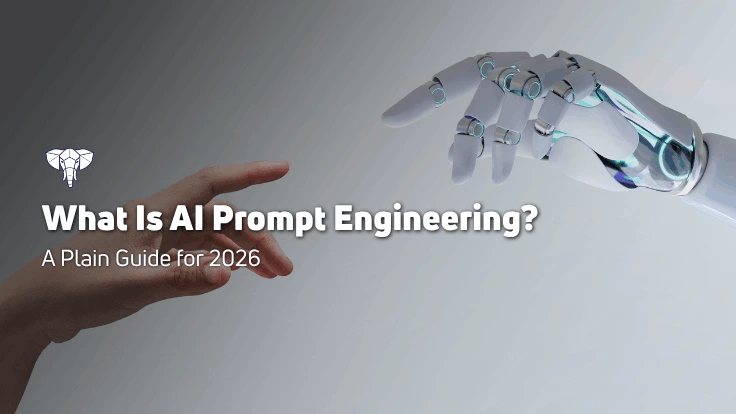
Every time you type a question into ChatGPT, Claude, or any other AI tool, you are writing a prompt. But there is a significant difference between a prompt that produces a vague, generic response and one that delivers exactly what you need. That gap is where AI prompt engineering comes in and why it has become one of the most in-demand skills in the AI era. In this article from TrainAI we gonna explain this concept. So, follow along as we break down.
What Is Prompt Engineering?
Prompt engineering is the practice of designing, refining, and optimising the inputs you give to a generative AI model in order to get the most accurate, useful, and relevant outputs possible.
In plain terms: it is the skill of knowing how to talk to AI effectively.
A prompt is any natural language instruction you give an AI — a question, a command, a description, or a combination of all three. Prompt engineering is the systematic process of crafting those instructions so the model understands not just your words, but your intent, context, and desired outcome.
The basic principle is straightforward: better prompts produce better results. But in practice, prompt engineering involves understanding how large language models (LLMs) process language, what kinds of instructions they respond to best, and how to structure inputs to guide the model reliably toward the output you need.
What Is Prompt Engineering in AI — and Why Does It Matter?
To understand what prompt engineering in AI actually means, it helps to understand what happens without it.
AI models are powerful, but they do not read minds. Feed a model a vague or ambiguous instruction and it will fill in the gaps — often in ways you did not intend. Prompt engineering eliminates that guesswork. It gives the model clear context, specific instructions, and enough information to produce a focused, high-quality response.
This matters enormously in professional settings. When AI is embedded in a product, powering a customer-facing chatbot, or running at scale across thousands of daily interactions, even small improvements in prompt quality translate into significantly better outcomes. As one leading prompt engineering researcher put it, few-shot prompting — showing the model examples of what you want — can improve accuracy from 0% to 90% on some tasks.
LinkedIn data shows a 250% increase in job postings related to prompt engineering in recent years. Whether or not “prompt engineer” becomes a standalone job title, the underlying skill — knowing how to get reliable, high-quality output from AI — is now a baseline competency for anyone working with AI tools professionally.
What Does Prompt Engineering Entail?
What prompt engineering entails goes well beyond typing better questions. At a professional level, it covers a range of techniques and skills:
Few-shot prompting: Providing the model with examples of the kind of output you want before asking it to produce something new. This dramatically improves consistency and accuracy.
Chain-of-thought prompting: Instructing the model to reason through a problem step by step rather than jumping to a conclusion — useful for complex analytical or reasoning tasks.
Role assignment: Telling the model to adopt a specific persona or expertise (“You are an experienced financial analyst…”) to shape the tone, depth, and style of its response.
Context management: Structuring prompts so the model has all the relevant background it needs — without overloading it with irrelevant information.
Iterative refinement: Treating prompt design as an ongoing process of testing, evaluating outputs, and improving instructions — much like debugging code.
Multimodal prompting: As AI systems expand beyond text to handle images, audio, and code, prompt engineers increasingly design inputs that span multiple media types.
Prompt Engineering for Generative AI: A Specific Focus
Prompt engineering for generative AI has its own distinct considerations. Generative models — those that create content like text, images, or code — are especially sensitive to how prompts are framed.
For text generation, the specificity of your prompt determines the specificity of the output. For image generation (tools like Midjourney or DALL-E), prompts must describe visual style, composition, mood, and detail. For code generation, prompts need to specify language, constraints, expected behaviour, and edge cases.
In product development, prompts embedded in applications are not one-off interactions — they run millions of times and must be robust, safe, and optimised like production code. This is where prompt engineering shifts from a conversational skill to a genuine engineering discipline.
Who Should Learn Prompt Engineering?
Prompt engineering is relevant across a wide range of roles — not just developers:
- Marketers and content creators using AI to scale content production
- Developers and engineers building AI-powered products and features
- Data analysts using AI to summarise and interpret large datasets
- Business professionals integrating AI tools into everyday workflows
- Product managers designing AI-assisted user experiences
If you interact with AI tools regularly — or plan to — prompt engineering skills will make you significantly more effective.
Take the Next Step with an AI Prompt Engineering Course
Understanding prompt engineering conceptually is one thing. Applying it consistently across real-world scenarios is another. Our AI prompt engineering course is designed to give you practical, hands-on experience with the techniques that matter most — from few-shot and chain-of-thought prompting to building reliable prompt workflows for generative AI systems.
Not sure if this is the right starting point for you? Visit our Career Quiz to answer a few quick questions and get a personalised recommendation for the AI courses best suited to your background and goals.