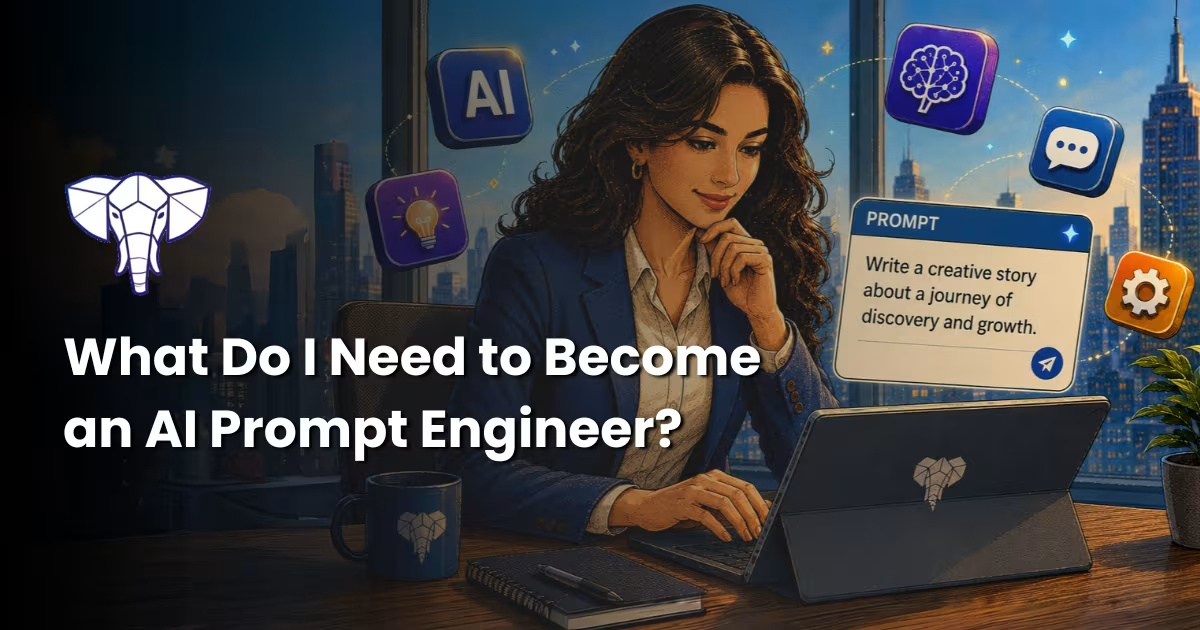
Short answer: less than you’d fear on the technical side, and more than you’d hope on the judgement side. You don’t need a computer science degree. You do need to prove you can make AI produce reliable, high-quality results on demand, which is a real skill, not a magic phrase.
But before listing qualifications, there’s something you need to know about the job itself in 2026, because it changes everything about how you should prepare.
First, an Honest Word About the Job Title
In 2023, “Prompt Engineer” was the headline-grabbing role with eye-watering salaries. Since then, the standalone job title has actually shrunk, roughly a third fewer postings use that exact title than at its peak. Skeptics love that number.
Here’s what they miss: the skill didn’t shrink, it spread. Roles that require prompt engineering — now titled things like AI Engineer, Applied AI Engineer, LLM Engineer, or AI Solutions Architect — have multiplied several times over. Prompt engineering went from a novelty job to a core competency baked into dozens of roles.
So the smartest way to “become a prompt engineer” in 2026 isn’t to chase that one title. It’s to build prompt fluency as a portable, high-value skill you can carry into a much wider set of jobs. Keep that in mind as you read the rest.
What Qualifications Do You Need to Be an AI Prompt Engineer?
There is no single mandatory qualification — no licence, no required degree. People break into this work from writing, marketing, linguistics, teaching, healthcare, and plenty of other non-technical backgrounds. What employers actually screen for is a stack of demonstrable abilities:
1. A real understanding of how LLMs work. Not the maths logic, but why models behave the way they do, where they fail, and how wording changes output. “Good at ChatGPT” no longer clears the bar.
2. Strong writing and analytical thinking. The job is communication under constraints: clear instructions, precise structure, anticipating ambiguity.
3. An evaluation mindset. This is the big one most beginners miss. Writing prompts is maybe 30% of the modern role. The other 70% is testing, measuring quality across edge cases, building evaluation frameworks, and iterating from data. Employers want people who can prove a prompt works, not just write one that looks good once.
4. Structured output and formatting. Getting models to return clean, usable formats (like JSON) that slot into real workflows.
5. Basic Python and API familiarity (for technical roles). Content-leaning roles often don’t require code. Engineering-leaning roles increasingly do, along with awareness of retrieval (RAG) and fine-tuning trade-offs.
6. Domain expertise. Knowing a field deeply, is often what makes you employable, because you can judge whether an AI’s answer is actually correct.
7. A portfolio. More on this below, it’s the single biggest differentiator.
A recognised credential helps you clear the first screen, especially if you’re switching fields. A structured ai prompt engineering course with certificate gives you the fundamentals, the vocabulary, and a signal employers recognise which is a sensible starting point before you build a portfolio on top.
If you’re weighing credentials generally, our guide on how to choose AI certifications employers value is worth a read.
How Much Do AI Prompt Engineers Make?
Wide ranges, for a real reason: the title covers everything from content-adjacent roles to deep technical positions.
In the US, multiple 2026 salary trackers put the average somewhere between roughly $110,000 and $145,000 — but the spread is what matters. Content-leaning roles can sit below $70,000, while engineering-heavy and senior positions reach $200,000 or more, with top AI labs going higher still. The variable that moves your pay isn’t how well you write a single prompt, but it’s technical depth, evaluation skill, and domain stakes.
A reality check for non-US readers: UK and EU salaries typically run lower than the US figures above, though demand is strong. Treat any headline number as directional and confirm against live postings before you negotiate.
The pattern is clear: the further your work moves from “writing prompts” toward “engineering and evaluating AI systems,” the higher the ceiling.
Can I Become an AI Prompt Engineer With No Experience?
Yes — with realistic expectations. Plenty of people enter from unrelated fields, and generalist prompt roles are most common at content, education, and creative companies. The route looks like this:
- Lead with what you already know. Your existing domain is an asset, not a gap.
- Get the fundamentals fast, ideally through a course that ends in a recognised certificate.
- Build a portfolio that proves it. This is non-negotiable. The market is full of people who can describe prompting and short on people who can ship. A published project — an LLM solving a real problem in your domain, with the prompts, the code where relevant, and rigorous evaluation of the results — is what turns “no experience” into “here’s proof.”
For the broader roadmap of moving into AI from scratch, our guide to starting an AI career with no experience maps out the other entry points alongside this one.
Where the Skill Takes You
Because prompt fluency now sits inside so many roles, it’s a strong foundation rather than a dead end. It leads naturally into AI engineering, evaluation and model-quality work, and the fast-growing area of AI agents, where designing and testing instructions is central. Build the skill well and you’re not betting on one job title — you’re qualifying for a whole category of work.
FAQs
How long does it take to become an AI prompt engineer?
The fundamentals can be learned in a few weeks of focused study, and a certificate is achievable in roughly that timeframe. Becoming genuinely employable usually takes a few months on top of that — the time it takes to build a portfolio of real, evaluated projects. Think weeks to learn, months to prove.
Is AI prompting a good career?
Yes — provided you treat it the way the 2026 market does: as a high-value skill embedded across many roles, not a single magic-bullet job title. Demand for the skill is rising even as the standalone title shifts, and it pairs well with adjacent abilities like evaluation, agent design, and retrieval. The people doing well are those who kept building beyond “I can write a good prompt.”
Can I learn prompt engineering in 2 months?
You can absolutely learn the core skills and earn a certificate in two months with consistent effort. What two months won’t automatically give you is a competitive portfolio — so use that time to both learn the fundamentals and start shipping small, evaluated projects you can show employers.