
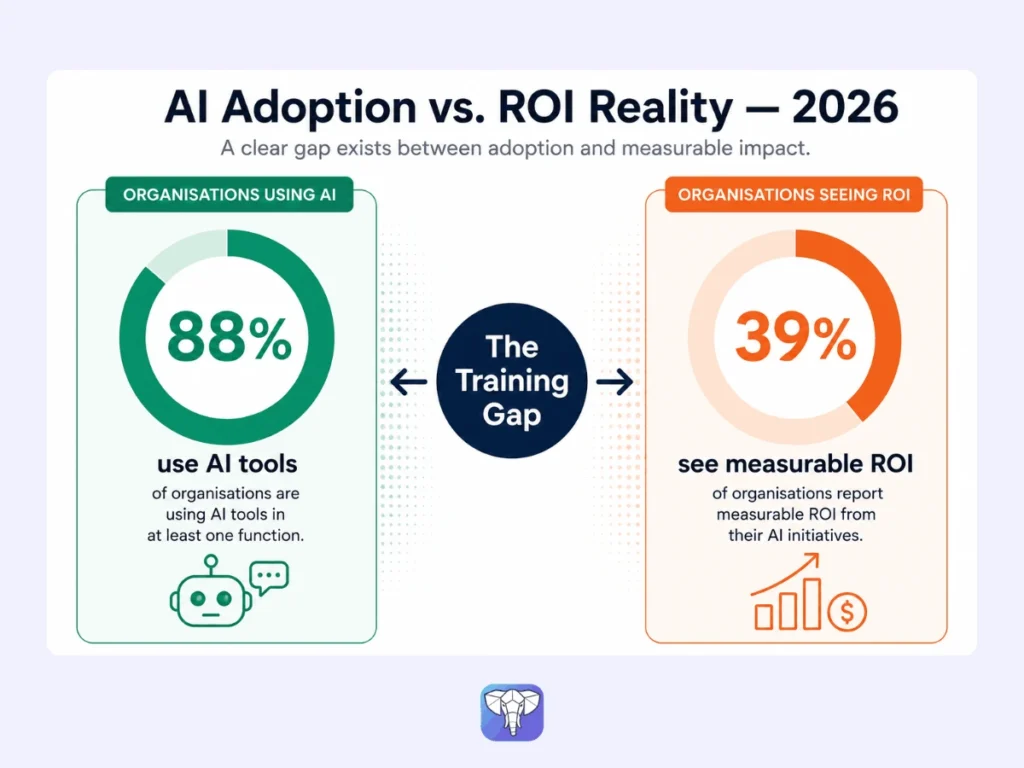
Most organisations are sitting on a costly contradiction right now. They have invested in AI tools, rolled out subscriptions, and pointed their teams toward new platforms, yet the results have been underwhelming. While 88% of organisations report using AI, only 39% have seen a measurable impact on EBIT, and 74% report no clear ROI.
The gap is not the technology. It is the training.
When employers provide structured AI training, adoption jumps to 76%, compared to just 25% without any formal support. The difference between an AI investment that pays off and one that quietly drains budget almost always comes down to how well employees were trained to use it.
This guide breaks down exactly how AI training for employees works, step by step. So, you know what a well-designed programme looks like and what to expect at each stage.
Why Most AI Training Efforts Fall Short
Before getting into the steps, it is worth understanding why so many attempts fail. 42% of employees say their employer expects them to learn AI on their own. That approach handing someone a tool and hoping for the best, is not training. It is abandonment dressed up as autonomy.
Among organisations with a mature, organisation-wide AI upskilling programme, reports of significant positive AI ROI nearly double compared to those without one. Structured capability building is the differentiator. Everything else is noise.
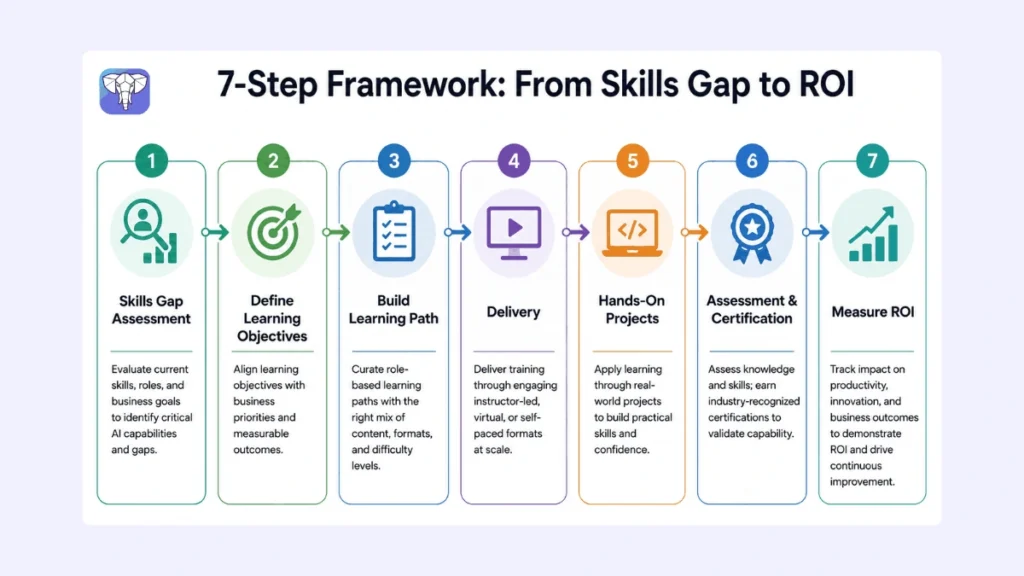
Step 1: Skills Gap Assessment
Every effective AI training programme begins before a single lesson is delivered. The first step is an honest audit of where your workforce currently stands.
This means identifying:
- Which roles interact with AI tools or should
- What level of AI literacy employees already have
- Where the highest-value upskilling opportunities sit within your specific workflows
- What business outcomes the training needs to drive
80% of employers cite skills gaps as their biggest barrier to transformation (source: Gartner), yet many skip this diagnostic step entirely and go straight to booking a course. The result is generic training that fails to land because it was never mapped to actual role requirements.
A proper assessment takes days, not weeks, and shapes everything that follows.
Step 2: Defining Learning Objectives by Role
AI training is not one-size-fits-all. A marketing manager, a software developer, and a customer service lead all need different AI skills like different tools, different use cases, different depth of technical understanding.
Once the skills gap is clear, the next step is translating it into role-specific learning objectives. This typically means segmenting employees into two or three capability tiers:
- AI-aware: understands what AI is and how it applies to their role; uses AI-assisted tools confidently
- AI-practitioner: can prompt, configure, and integrate AI tools into daily workflows; evaluates outputs critically
- AI-builder: can design, deploy, and maintain AI-enabled systems; understands model behaviour and limitations
Each tier requires a different curriculum, a different time commitment, and a different measure of success.
Step 3: Building the Learning Path
With objectives defined, the programme structure takes shape. This is where good AI training providers earn their value, not by delivering off-the-shelf content, but by designing a learning path that connects theory to the employee’s actual working environment.
A well-structured AI training path for employees typically includes:
- Foundational modules: AI concepts, terminology, and how large language models work at a practical level
- Tool-specific training: hands-on sessions with the specific AI platforms the organisation uses (Copilot, ChatGPT Enterprise, Gemini, custom LLM integrations)
- Workflow integration: applying AI to real tasks: writing, analysis, coding, customer communication, decision support
- Ethics and governance: responsible use, data privacy, output validation, and knowing when not to rely on AI
- Capstone projects: applied work that mirrors real job tasks, producing portfolio evidence and consolidating learning
AI-driven personalised learning has been shown to increase employee engagement by 30% and improve learning outcomes by 25%. The best programmes adapt the learning path as employees progress rather than delivering a fixed sequence regardless of pace or prior knowledge.
Step 4: Delivery — How the Training Is Actually Run
Delivery format matters as much as content. e-Learning requires 40–60% less time to complete compared to traditional classroom training, and 58% of employees prefer to learn at their own pace. That said, purely self-directed learning has a completion problem without structure and accountability, drop-off rates are high.
The most effective delivery model in 2026 combines:
- Self-paced online modules for foundational and conceptual content
- Live instructor-led sessions (virtual or in-person) for applied practice, Q&A, and accountability
- Cohort learning: small groups working through challenges together, which improves both retention and motivation
- On-the-job application tasks between sessions, tying learning directly to real work
As one of the providers delivering AI Training in UK to organisations across industries, we have found that the cohort model consistently outperforms solo e-learning on both completion rates and measurable skill transfer. Employees learn better when they are working through real problems alongside peers who face the same organisational context.
Step 5: Hands-On Projects and Applied Learning
This is the step most corporate training programmes skip and it is the most important one.
Trained employees are 2.7x more proficient than self-taught workers, and the gap is almost entirely explained by the presence or absence of structured, hands-on practice. Reading about prompt engineering is not the same as spending three hours building a prompt chain that solves an actual business problem.
If you are new to this, read our guide on What is Prompt Engineering and Why Does It Matter.
Applied projects in a well-designed AI training programme look like:
- Building an AI-assisted content workflow for a marketing team
- Creating a custom GPT or Copilot configuration for a specific department
- Automating a repetitive reporting task using AI tools
- Evaluating and quality-checking AI-generated outputs against real standards
These are not theoretical exercises. They are the bridge between knowing and doing and they produce something tangible the employee can point to.
Step 6: Assessment and Certification
At the end of each module or programme stage, employees should be assessed, not just to satisfy compliance requirements, but to give both the individual and the organisation a clear signal of what has been absorbed.
Effective assessment in AI training combines:
- Knowledge checks: understanding of concepts, terminology, and responsible use principles
- Practical demonstrations: completing a task using AI tools under assessment conditions
- Project review: evaluation of the applied work produced during the programme
Certification at the end of each stage gives employees a credential they can reference and gives HR a verifiable record of capability. For organisations operating in regulated sectors, this documentation also supports governance and compliance requirements.
Step 7: Measuring ROI
Training without measurement is guesswork. AI tools alone do not create ROI, workforce capability does. To demonstrate the return on an AI training investment, organisations should track:
- Productivity metrics: time saved per task, volume of work completed, error rates before and after training
- Adoption rates: percentage of employees actively using AI tools post-training vs. pre-training
- Quality of output: subjective manager assessments and peer review of AI-assisted work
- Retention signals: 55% of employees say access to AI training or certification would make them more likely to stay with their employer, making training measurable as a retention investment
Formal AI training programmes deliver a measurable ROI of $3.70 per dollar invested when tracked properly. That figure compounds as trained employees embed new habits into daily workflows.
Ready To Transform Your Business?
Leave your details and we’ll call you back to talk through what AI training could look like for your team.
How Long Does AI Training for Employees Take?
It depends on the depth of the programme and the starting point of the cohort. As a general guide:
| Programme Level | Duration |
|---|---|
| AI awareness / literacy | 1–2 days |
| Practitioner (tool-specific) | 4–6 weeks |
| Full AI engineering track | 2–3 months |
Most organisations see the strongest ROI from a practitioner-level programme delivered over four to six weeks which is deep enough to change behaviour, short enough to maintain momentum.
The Bottom Line
AI training for employees is not a single event. It is a structured process: assess, design, deliver, apply, measure, and iterate. Organisations that follow that process are nearly twice as likely to see strong AI ROI than those that treat training as an afterthought.
The companies pulling ahead in 2026 are not necessarily the ones with the most sophisticated AI tools. They are the ones whose people know how to use them.
2 responses
I like how you point out that leaving employees to learn AI independently isn’t really training. Structured programs seem like the key differentiator in driving real results, and it really shows that proper support can turn tools into tangible outcomes.
Exactly! access without structure is just noise. The real lift comes when people understand not just how to use the tools, but why and when to apply them. That’s where structured programs earn their keep.