Most businesses have already made the AI investment. The tools are licensed, the subscriptions are running, and leadership has signed off on the vision. What many organisations have not yet done is build the capability their people need to make those tools actually work.
As a provider of AI Training in UK, this is one of the most common issues we see in workplaces, not a lack of willingness to invest, but a lack of structure around how that investment is delivered. The question is not whether to train your people. It is how to do it in a way that produces lasting, measurable change rather than a workshop employees forget by Friday.
Start With the Business Case, Not the Curriculum
The most common mistake organisations make when implementing AI training is starting with the content rather than the objective. They book a course, send out a calendar invite, and call it an AI training programme.
That approach rarely sticks, and it rarely gets budget approved twice.
Before anything else, anchor the programme to a specific business outcome. Are you trying to reduce time spent on manual reporting? Improve the speed and quality of customer communications? Accelerate your development team’s output? Reduce headcount pressure without reducing output?
Organisations with formal AI training programs are 2.6x more likely to report measurable business value from their AI investments, according to PwC’s 2025 AI Business Survey. That figure becomes your business case. The training is not a cost, it is the bridge between the tools you are already paying for and the results you are not yet seeing.
Step 1: Audit Where Your Organisation Actually Stands
Before you design anything, you need an honest picture of where your workforce is today.
This means asking:
- Which teams are already using AI tools and how confidently?
- Where are the highest-volume, most repetitive tasks that AI could accelerate?
- What AI tools does the business already have licensed?
- What are the biggest blockers to adoption, lack of skills, lack of trust, lack of clarity on policy?
While 70% of professionals use AI weekly, only 56% feel confident choosing the right tool for a specific task, and just 14% consider themselves advanced users. That gap between usage and confidence is where training has the most leverage.
A proper audit takes a few days, not weeks. It can be done through a short survey, a handful of team-level conversations, and a review of which tools employees actually open versus which ones sit unused. The output should be a clear map of capability gaps by team and role, not a generic observation that “employees need AI skills.”
Step 2: Get Leadership Buy-In Before You Go Wider
AI training programmes that start from the bottom up almost always stall. Employees attend a session, find it useful, go back to their desks, and revert to old habits. Why? because nothing in their immediate environment reinforces the change.
Only 50% of employees say leadership has communicated a clear AI strategy. Without that direction, 47% feel unsure about AI in the workplace.
Leadership buy-in is not just about budget. It is about signal. When senior leaders visibly champion the programme — when they talk about it in all-hands meetings, when managers are trained first, when AI capability becomes part of performance conversations — adoption follows. When they do not, even excellent training quietly fades.
Brief your executive team on the ROI case first. Share the productivity data. Frame training as an asset protection strategy that the business has invested in AI tools, and the training is what makes that investment pay off.
Not sure why AI training should be a priority?
Before getting into the how, it helps to be clear on the why.
Step 3: Segment Your Workforce by Role and Capability Tier
Not everyone in your organisation needs the same AI training. Designing a single programme for 200 people with wildly different roles and starting points is one of the fastest ways to waste budget and lose credibility with employees.
Segment your workforce into two or three capability tiers:
- AI-aware — needs foundational literacy: what AI is, how to interact with tools safely, where it applies to their role
- AI-practitioner — needs applied skills: prompt engineering, workflow integration, output evaluation, tool-specific training
- AI-builder — needs technical depth: model configuration, automation design, API integrations, deployment considerations
Each tier gets a different programme, a different time commitment, and different success metrics. The practitioner tier is where most organisations should focus first which covers the majority of knowledge workers and delivers the fastest measurable productivity gains.
Step 4: Choose the Right Delivery Model
How the training is delivered matters as much as what is in it. BCG research found a clear threshold: employees who receive at least 5 hours of AI training show significantly higher regular usage and confidence. The challenge is getting employees past that threshold without disrupting operations.
The most effective delivery model for workplace AI training combines:
- Self-paced online modules for foundational content — flexible, low-disruption, completable in short blocks
- Live cohort sessions for applied practice — small groups working through real workflow challenges together, with an instructor present
- Manager-led reinforcement between sessions — brief team check-ins that connect training content to actual work happening that week
- Capstone projects — applied work the employee builds during the programme, producing both skill consolidation and portfolio evidence
Avoid the one-day workshop model. It feels efficient and almost never produces lasting behaviour change. The learning needs to be spaced, reinforced, and connected to real work.
Step 5: Build in Governance and Responsible Use From Day One
One of the most overlooked components of any workplace AI training programme is responsible use. Many organisations train employees on how to use AI tools without ever addressing when not to use them, what not to input, or how to evaluate outputs critically.
This is both a risk management issue and a cultural one. Your training programme should include:
- Data privacy and input hygiene — what information is safe to put into AI tools, and what is not
- Output validation — how to check AI-generated content for accuracy, bias, and appropriateness before acting on it
- Acceptable use policy — clear organisational guidelines on which tools are approved, for which tasks, and under what conditions
Building governance into the training from the start is far easier than retrofitting it after an incident.
Step 6: Measure, Report, and Iterate
Training without measurement is guesswork. Before the programme launches, define the metrics you will use to evaluate it, and make sure they connect to the business outcomes you identified at the start.
Useful metrics to track:
- Adoption rate — percentage of employees actively using AI tools 30, 60, and 90 days post-training
- Time saved — self-reported or manager-assessed time reduction on targeted tasks
- Output quality — before/after assessment of work quality on AI-assisted tasks
- Confidence scores — employee self-assessment at start, mid-point, and end of programme
- Completion rate — percentage of enrolled employees completing the full programme
Report results to leadership quarterly, not just at the end. This keeps the programme visible, maintains momentum, and gives you the evidence base to expand it to additional teams.
What to Look for in an AI Training Provider
If you are running the programme with an external provider rather than entirely in-house, the selection criteria matter. Look for:
- Role-specific curriculum — not generic AI content repurposed for every audience
- Hands-on project work — evidence that employees will build something, not just watch something
- Recognised certification — credentials employees can point to and employers can verify
- Measurable outcomes — a provider willing to define and track success metrics alongside you
Ready to build AI capability across your organization?
TrainAI delivers structured, hands-on AI training programmes designed specifically for business teams. Role-specific, project-based, and built around.
BOOK YOUR FREE CALL NOW!
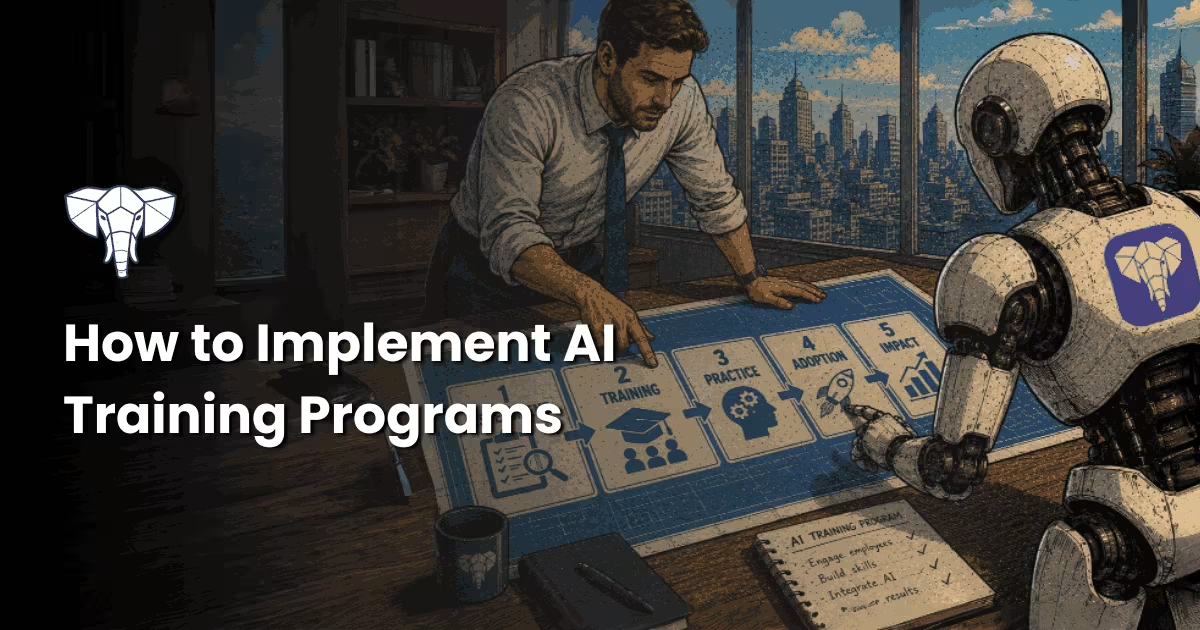
The Implementation Checklist
Before you launch, make sure you have covered:
- Business outcome defined and signed off by leadership
- Workforce audit completed and capability gaps mapped by team
- Employees segmented into capability tiers
- Delivery model selected and provider confirmed
- Responsible use and governance content included
- Success metrics defined and baseline data captured
- Manager briefing completed before employee rollout begins
Final Thought
Implementing an AI training programme is not a one-time project. It is an ongoing capability-building process, because the tools are evolving, the use cases are expanding, and the baseline keeps moving. The organisations that will be ahead in two years are the ones that treated AI training as infrastructure, not a tick-box exercise.
Start with one team. Measure it properly. Then scale what works.