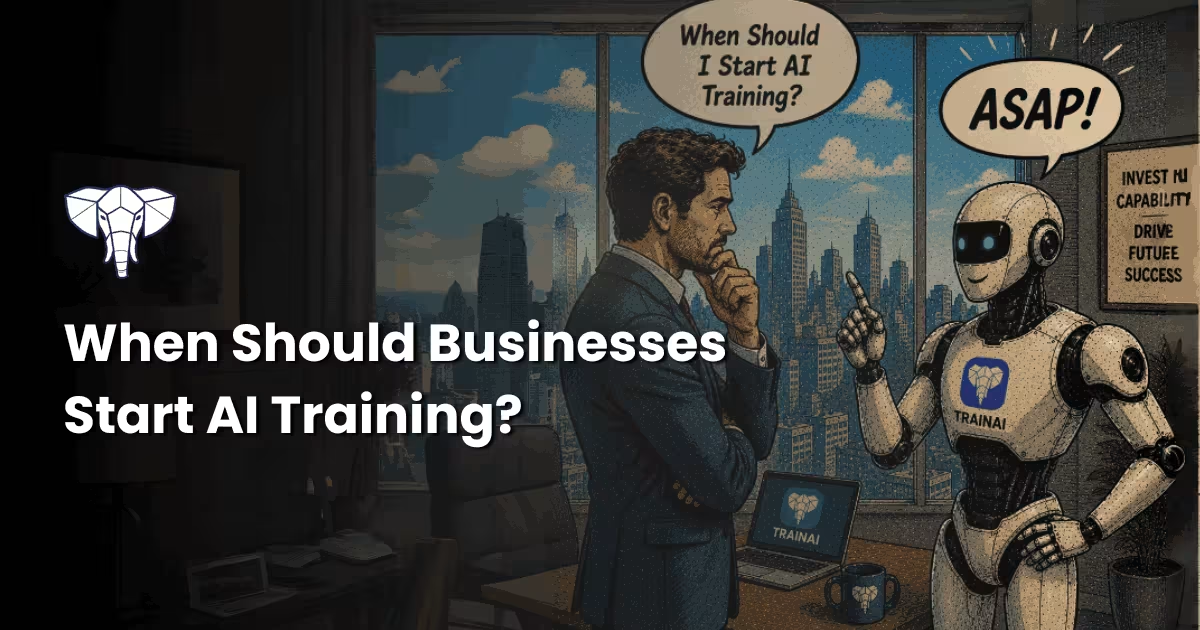
The short answer: before you feel ready. The honest answer: most businesses are already late.
If you’re asking the question, something has probably already happened. A competitor mentioned AI in their pitch. Someone on your team quietly automated half their reporting. Or your inbox has started filling with tools you don’t quite understand but feel you should. That uneasy feeling has a name, it’s the signal that the right time has arrived.
This post breaks down when businesses should start AI training, the warning signs you’re leaving it too late, and how to begin without turning it into a six-month corporate initiative.
The Best Time Was Yesterday. The Second-Best Time Is This Quarter.
AI adoption in UK workplaces hasn’t followed the usual technology curve. With most new software, waiting a year or two is a reasonable strategy, let someone else find the bugs. AI is different, because the gap it creates isn’t technical. It’s a skills gap, and skills gaps compound.
An employee who started using AI tools a year ago hasn’t just saved time. They’ve built judgement: knowing when to trust an output, when to push back, when a task isn’t worth automating at all. That judgement can’t be installed overnight. It has to be trained, practised, and corrected, which is exactly why “we’ll deal with it next year” quietly becomes “we’re now two years behind.”
So when should businesses start AI training? As soon as any of the following are true:
- Your team is already using AI informally. If employees are pasting company information into free chatbots, you don’t have an adoption question anymore, you have a governance one. Training turns shadow usage into safe usage.
- Your competitors are talking about it. By the time AI shows up in a rival’s marketing, it’s been in their operations for months.
- You’re hiring. Candidates increasingly expect AI literacy to be part of the role. Training your existing team is considerably cheaper than recruiting around the gap.
- Repetitive work is eating skilled hours. If your best people spend afternoons on tasks a well-prompted model could draft in minutes, every month of delay has a measurable cost.
If none of those apply to your business, you may genuinely be one of the rare organisations that can wait. Most can’t.
Read More: How to Implement AI Training in Workplaces
The Stages of “Too Early” (Spoiler: There Aren’t Many)
A common objection is that the technology changes too quickly, why train staff on tools that will look different in six months?
It’s a fair question with a slightly unfair premise. Good AI training isn’t really about tools. The interfaces will change; the underlying skills won’t. Writing a clear brief, evaluating an output critically, spotting hallucinations, understanding what data should never leave the building — these transfer across every model and every update. Training people in thinking with AI, rather than clicking through one specific product, is what makes the investment durable.
There are only two situations where “too early” holds up:
- You have no use case at all. Genuinely none — no documents, no emails, no data, no customer communication. (If you’re reading this on a screen, this probably isn’t you.)
- Leadership hasn’t decided why. Training without a purpose produces certificates, not change. If you can’t yet answer “what do we want people to do differently afterwards?”, spend a fortnight answering that first. Then start.
Everything else like budget worries, busy quarters, waiting for the technology to “settle” — tends to be a delay dressed up as a strategy.
You might also like: Why AI Training Is Important
What Starting Actually Looks Like
Starting AI training doesn’t mean enrolling the entire company on day one. The businesses that do this well tend to follow a quieter pattern:
Start with a pilot group. Pick five to ten people across different functions, not just the tech-curious ones. Mixed groups surface the use cases leadership never thought of.
Train for your context, not in the abstract. Generic “introduction to AI” sessions are forgettable. Training built around your actual workflows — your documents, your customer queries, your reporting — sticks. If you’re curious about the format, we’ve written about what happens in an AI training session in more detail.
Set rules before scale. A short, plain-English AI usage policy (what’s allowed, what’s confidential, who to ask) prevents most of the problems that make headlines.
Measure something small. Hours saved on one recurring task is enough. You’re not proving AI works; you’re proving it works here.
As a UK AI training provider, we see the same pattern repeatedly: the companies that start with a modest, well-defined pilot move faster within six months than the ones that spent those six months planning a perfect rollout.
The Cost of Waiting (The Part Nobody Budgets For)
Delaying AI training feels free because nothing visibly breaks. But the costs accumulate in places that don’t appear on a spreadsheet:
- Skilled employees doing work below their skill level
- Informal, unmonitored AI use creating data risks
- Slower proposals, slower reporting, slower everything by margins small enough to ignore individually
- Talented staff leaving for companies that do invest in modern skills
None of these arrives with an invoice. All of them compound.
So, When Should Your Business Start?
If your team handles information, communicates with customers, or produces anything written, the realistic answer is now, beginning small. Not with a grand transformation programme. With a pilot, a policy, and a few people learning to think clearly alongside the tools.
The businesses asking “when should we start AI training?” in 2026 will, in 2027, mostly wish they’d answered “last year.”
Ready to Stop Asking “When”?
Leave your details and we’ll call you back to talk through what AI training could look like for your team.