Artificial intelligence is no longer a futuristic concept reserved for tech giants. It has become the backbone of modern marketing strategy. Whether you are a small business owner, a digital marketer, or someone exploring an AI marketing course to advance your career, understanding what AI marketing is and how it works has never been more important.
In this guide, we break down the AI marketing meaning, explore real-world examples, and show you why learning AI for marketing is one of the smartest career moves you can make in 2026. So, let’s dive in!
What Is AI Marketing? (Definition)
AI marketing is the practice of using artificial intelligence technologies — including machine learning, natural language processing (NLP), and predictive analytics — to automate marketing decisions, personalize customer experiences, and optimize campaign performance based on data.
Put simply, AI marketing means using intelligent software to do what used to require entire marketing teams: analyzing audience behavior, generating content, optimizing ad spend, and delivering the right message to the right person at the right time.
Unlike traditional marketing, which is largely reactive — you run a campaign, wait for results, then adjust — AI marketing is proactive. It predicts outcomes, optimizes in real time, and continuously learns from every interaction.
AI Marketing Meaning: More Than Just Automation
A common misconception is that AI marketing is just about automation. While automation is a big part of it, the AI marketing meaning goes much deeper.
AI marketing involves:
- Data collection and analysis at a scale no human team can match
- Predictive modelling to anticipate customer behavior before it happens
- Hyper-personalization — tailoring messages to individuals, not just segments
- Real-time decision-making across multiple channels simultaneously
- Content generation using generative AI tools
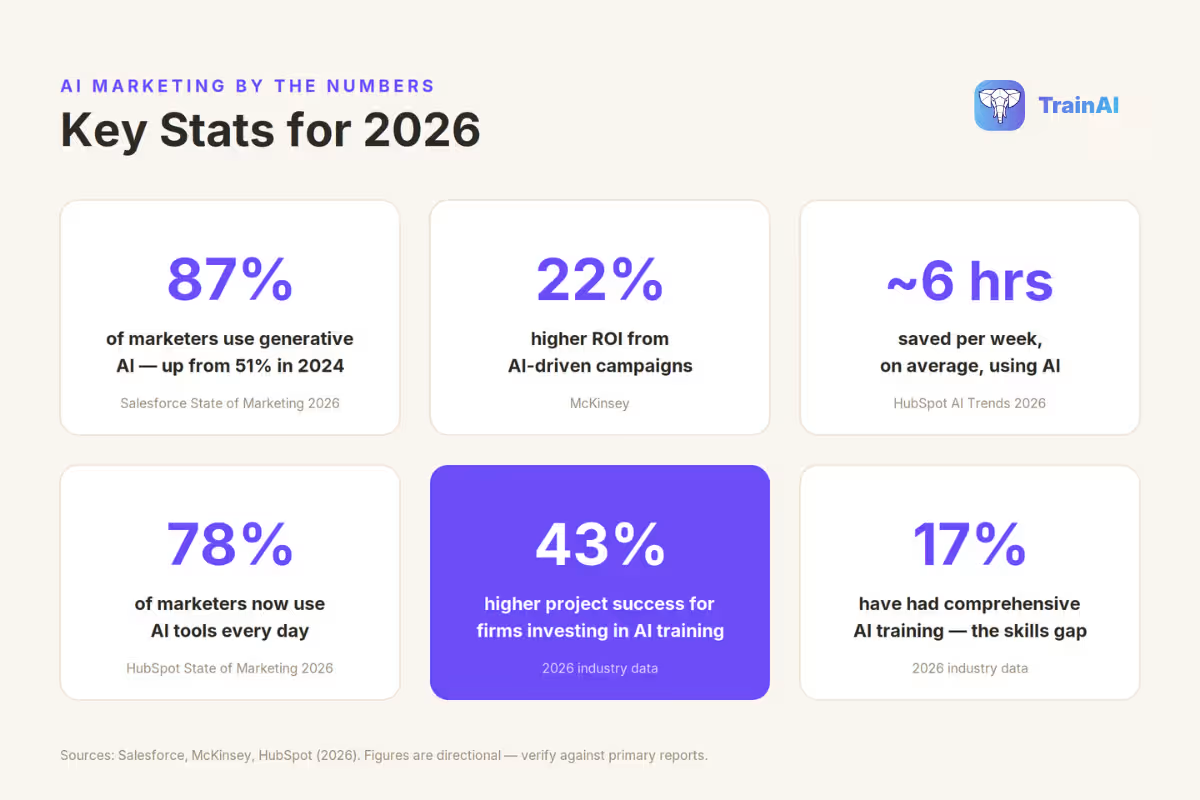
According to McKinsey’s latest State of AI research, 82% of organisations now use AI in at least one business function — with marketing and sales among the most common. And the payoff is measurable: AI-driven marketing campaigns deliver around 22% higher ROI, 32% more conversions, and 29% lower customer-acquisition costs (McKinsey) — a compelling case for any marketer or business leader.
AI in Marketing Examples: Real-World Applications
One of the best ways to understand AI marketing is through concrete AI in marketing examples from companies already putting it to work.
1. Netflix — Personalized Recommendations
Netflix’s recommendation engine analyses viewing history, watch time, genre preferences, and even the time of day you watch — then suggests content tailored to each individual user. This AI-powered system is estimated to save the company over $1 billion annually through reduced churn.
2. Amazon — Predictive Product Suggestions
Amazon’s AI analyses purchase history, browsing behavior, and basket data to surface products each customer is most likely to buy next. This personalized recommendation system drives a significant portion of Amazon’s total revenue.
3. Google Ads — Smart Bidding
Google’s machine learning algorithms automatically adjust ad bids in real time based on hundreds of signals: device type, location, time of day, search intent, and more. Advertisers using Smart Bidding consistently see improved conversion rates without manual intervention.
4. Sephora — AI-Powered Chatbots
Sephora uses AI chatbots to help customers find products, check availability, and receive personalized beauty recommendations — 24 hours a day, without human agents needing to be involved in routine queries.
5. Pinterest — Taste Graph & Performance Campaigns
Pinterest’s AI-powered “taste graph” processes billions of signals to understand user preferences. Their Performance+ campaigns have reportedly outperformed traditional setups by delivering more than a 20% reduction in cost-per-acquisition for advertisers.
These AI in marketing examples illustrate that AI is not a single tool — it is an ecosystem of technologies that touches every part of the customer journey.
Key Components of AI Marketing
To fully grasp AI marketing, it helps to understand its building blocks:
Machine Learning (ML): Algorithms that analyze data and improve over time without being explicitly reprogrammed. ML powers everything from email personalization to ad targeting.
Natural Language Processing (NLP): Enables machines to understand and generate human language. NLP is behind AI writing tools, chatbots, sentiment analysis, and voice search optimization.
Predictive Analytics: Uses historical data to forecast future customer behavior — which customers are likely to churn, which leads are likely to convert, and which products are likely to sell.
Generative AI: Tools like ChatGPT or AI agents can draft blog posts, ad copy, email subject lines, and social media content at scale. Adoption is now near-universal — 87% of marketers use generative AI in at least one workflow in 2026, up from just 51% in 2024 (Salesforce State of Marketing 2026).
Computer Vision: AI that can analyze images and video — used in visual search, social media monitoring, and ad creative testing.
The Benefits of AI Marketing
Marketers and businesses adopting AI are seeing tangible results across the board:
Efficiency gains: AI automates repetitive tasks — data entry, report generation, A/B testing, email scheduling — freeing up marketers to focus on strategy and creative work. Research shows marketers now save around six hours per week on average using AI tools (HubSpot AI Trends 2026).
Better personalization: Around 71% of consumers expect personalized interactions, and 76% feel frustrated when they don’t get them (McKinsey). AI makes one-to-one personalization scalable and achievable even for smaller brands.
Improved ROI: AI reduces wasted ad spend by showing your message to people who are most likely to act on it. Smarter targeting means more conversions for the same or lower budget.
Faster decision-making: AI-enhanced dashboards surface insights in near real time, allowing marketers to respond to performance data as it happens rather than waiting for end-of-month reports.
Scalable content production: AI tools can generate hundreds of ad variations, email sequences, and product descriptions in the time it would take a human to write one — while maintaining brand voice.
AI Marketing Challenges to Be Aware Of
AI marketing is not without its hurdles. Understanding these challenges is essential for any marketer looking to deploy these tools effectively.
Data quality: AI is only as good as the data it is trained on. Poor-quality or outdated data leads to inaccurate insights and flawed decisions.
Data privacy and ethics: Regulations around how businesses collect and use customer data (such as GDPR in the UK and Europe) mean AI marketers must stay compliant. Data governance has moved from afterthought to board-level concern — data leakage through AI tools is now cited by 61% of CMOs as a top risk (2026).
AI bias: If training data reflects historical biases, AI systems can perpetuate or amplify them. Human oversight remains essential.
Over-reliance on automation: AI excels at scale and speed, but it lacks human nuance, emotional intelligence, and brand intuition. The most effective approach combines AI efficiency with human creativity.
Learning curve: Deploying AI tools effectively requires skill — and right now that’s the gap. 58% of marketers name the skills gap as their biggest AI challenge, yet only 17% have received comprehensive AI training (2026). Marketers who invest in AI courses for marketing are significantly better positioned to capitalize on these technologies.
Who Should Learn AI Marketing?
AI marketing skills are valuable across a wide range of roles:
- Digital marketers looking to automate campaigns and improve ROI
- Content creators who want to use AI to scale their output without losing quality
- Marketing managers responsible for team productivity and campaign performance
- Business owners aiming to compete with larger brands using smarter tools
- Career changers looking to start an AI career with no experience and want enter one of the fastest-growing areas of digital marketing
If any of these sound like you, an AI course for marketers is your most direct route to building these skills. Demand for AI marketing specialists is growing rapidly — and those who understand not just how to use the tools, but why and when to use them, will have a significant competitive edge.
How to Get Started with AI Marketing
Getting started with AI marketing does not require a technical background. Here is a practical approach:
1. Start with your goals. Identify where AI can solve a real problem — whether that is reducing content creation time, improving email open rates, or making your ad spend go further.
2. Clean up your data. AI tools perform best with high-quality, well-organized data. Audit your CRM, website analytics, and customer records before introducing AI.
3. Choose one or two tools. Rather than adopting every AI tool at once, start with a focused use case. Test, measure, and expand gradually.
4. Invest in your skills. The marketers seeing the greatest results from AI are those who understand how these systems work — in fact, companies that invest in AI training report 43% higher project success rates (2026). Look for a course or online program that combines practical tool training with strategic thinking.
5. Maintain human oversight. Use AI for speed and scale, but keep humans in the loop for brand voice, ethics, and high-stakes decisions.
Ready to Master AI Marketing?
The shift towards AI-powered marketing is already underway. In 2026, 78% of marketers worldwide use AI tools in their daily workflow (HubSpot State of Marketing 2026) — and the gap between those who use AI well and those who don’t is widening fast.
Those who develop AI marketing skills now are positioning themselves ahead of the curve.
Whether you are looking to upskill in your current role or transition into a career as an AI marketing specialist, the right training makes all the difference. Our AI marketing specialist course is designed specifically for marketers — no coding required, just practical, applicable skills you can use from day one and become a more effective, future-ready marketer.